
The sectoral pension plan JC 302 is the social sector pension scheme of Joint Committee 302 for the hotel industry, which covers horeca. Since 1 January 2013, blue-collar and white-collar staff in restaurants, hotels, cafés and caterers build up a pension on top of their statutory pension. The employer pays 0.97% of the reference wage for the pension and 0.04% for solidarity. Including the special contribution, the NSSO collects 1.10%. You pay it with your usual NSSO contributions; the employee pays nothing.
This guide covers the sector pension of JC 302. How sector plans work in general and how they differ per committee is explained in our guide to the sectoral pension plan. The committee's wages, bonuses and other fund contributions are in the guide to joint committee 302.
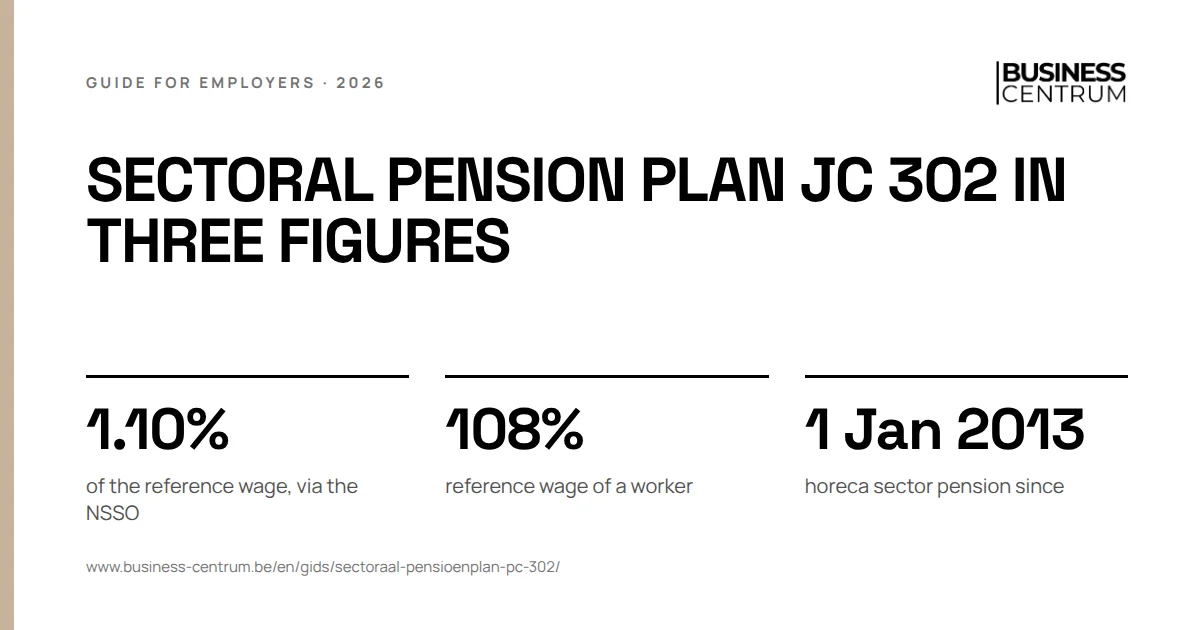
Sectoral pension plan JC 302 at a glance
| Item | What applies |
|---|---|
| In force since | 1 January 2013 |
| Who | Blue-collar and white-collar staff of a JC 302 employer, not extras |
| Pension contribution | 0.97% of the reference wage |
| Solidarity contribution | 0.04% of the reference wage |
| Together, excluding special contribution | 1.01% |
| What the NSSO collects | 1.10%, including the special contribution of 8.86% |
| Reference wage | blue-collar 108%, white-collar 100% of gross pay |
| Employee contribution | None |
| Organiser | Second Pillar Fund JC 302 (Fonds Tweede Pijler PC 302) |
| Pension institution | AG Insurance, the only one since 1 July 2021 |
| Type of plan | Deferred capital with refund of the reserve on death, with a guaranteed return |
| Rules | CLA of 11 December 2024 (no. 191531/CO/302) |
The basis is the CLA of 28 June 2012 (no. 110552/CO/302), which introduced the scheme. Since then several CLAs have adjusted the contribution, the reference wage and the pension institution. The CLA of 11 December 2024 replaces the pension rules and the solidarity rules, to bring them in line with the transparency law for the second pillar.
Who builds up a pension under the sectoral pension plan JC 302?
The plan applies to employees of employers that fall under JC 302 and are declared in the DmfA under employer category 017 or 417. The CLA of 11 December 2024 lists the worker codes: 011, 015, 024, 484 and 495. These are the codes of ordinary blue-collar and white-collar staff. Enrolment is automatic from the date on which the employee meets the conditions.
Three groups fall outside:
| Who | Why |
|---|---|
| Occasional workers (extras) | The CLA expressly excludes them |
| Apprentices | Even from 1 January of the year they turn 19 and fall under an ordinary worker code, the CLA excludes them |
| Companies with their own plan on 22 June 2011 | Outside the scope, if they certified equivalence by registered letter no later than 1 October 2012 |
If you work with extras, you pay no sector pension for them. How the extra status works, with the flat-rate NSSO contribution and the quota, is explained in our guide to occasional workers in horeca. For flexi-jobbers and students, look at the worker code under which you declare them in the DmfA: if it is not on the CLA's list, they build up nothing through this plan. The flexi-job rules are in our article on flexi-jobs in horeca.
An opting-out, where an employer replaces the sector plan with its own plan, does not exist in JC 302. The 2012 CLA expressly did not adopt that option. Your own group insurance on top of the sector pension is possible, but it replaces nothing.
How much is the sectoral pension plan JC 302 contribution?
The contribution has been unchanged since 1 January 2020. It has three parts:
| Part | Percentage of the reference wage | Where it goes |
|---|---|---|
| Pension allowance | 0.97% | individual account with AG Insurance |
| Solidarity contribution | 0.04% | the sector's solidarity fund |
| Special contribution | 8.86% on the pension allowance | NSSO |
| Total collected by the NSSO | 1.10% |
The 1.10% is a rounded figure. The exact sum is 0.966%, plus 8.86% of that, plus 0.044%: slightly under 1.10%. The NSSO itself states that for a sector plan it collects, the special contribution of 8.86% is included in the contributions collected. You therefore do not calculate or declare it separately.
The reference wage. The contribution is not charged on the full NSSO wage but on the reference wage: the gross pay of the quarter that you declare in the DmfA under remuneration codes 01, 03, 04, 07, 14 and 15. For blue-collar workers this pay counts at 108%, for white-collar employees at 100%. What the codes cover:
| DmfA code | What falls under it |
|---|---|
| 01 | All amounts always treated as pay, except what falls under another code |
| 03 | Termination payments expressed in working time |
| 04 | Termination payments not expressed in working time |
| 07 | Single holiday pay on leaving, for white-collar staff |
| 14 | Top-up of single holiday pay at the final settlement |
| 15 | Single holiday pay for days the employee could not take, for example due to illness |
Code 15 has counted since 1 January 2025. A payment in lieu of notice (codes 03 and 04) therefore also raises the reference wage. How the DmfA works is explained in what is the DmfA.
How the contribution has grown
The horeca sector pension started small and has been raised twice:
| From | Total collected by the NSSO |
|---|---|
| 1st quarter 2013 | 0.50% |
| 1st quarter 2015 | 1% |
| 1st quarter 2020 | 1.10% |
Anyone who has worked in the sector since 2013 built up the first years at a lower rate. That explains why the pension statement of an experienced cook is sometimes lower than a colleague expects.
Worked example: the sector pension for a hospitality employee
A full-time worker in category V at the starting rate earns at least € 2,780.38 a month in 2026 for 38 hours a week. The full table is on the JC 302 pay scale page.
- Gross pay over a quarter: € 2,780.38 x 3 = € 8,341.14.
- Reference wage at 108%: € 9,008.43.
- Pension allowance: € 9,008.43 x 0.97% = € 87.02.
- Special contribution: € 87.02 x 8.86% = € 7.71.
- Solidarity contribution: € 9,008.43 x 0.04% = € 3.96.
- Total per quarter: € 98.69, or € 394.76 a year and € 32.90 per calendar month.
A white-collar employee on the same gross pay costs less, because the reference wage counts at 100%: € 91.39 per quarter, or € 365.56 a year. In JC 302 the Horeca Fund pays the year-end bonus, not you, so this example only uses the monthly pay. How that bonus works is in our guide to the end-of-year bonus JC 302.
What does the employee build up? Over ten years on the same pay, € 3,480.80 in pension allowances, before indexation, costs and return. It is a supplement, not a second pension. What your employee keeps in net pay is explained in gross to net. After the January indexation the base rises too; what that means in horeca is in indexation JC 302 in January 2027.
How you pay: through the NSSO
You do not transfer the sector pension to AG Insurance yourself. The NSSO collects the contributions each quarter with your social security contributions and passes them via the organiser to the pension institution and the solidarity fund. Your role is a correct DmfA:
- Every employee has the right worker code and your company is in category 017 or 417.
- Pay is declared under the right remuneration codes, so the reference wage is correct.
- Blue-collar and white-collar staff are classified correctly, because that decides between 108% and 100%.
- Start and end dates are correct in the Dimona declaration, so enrolment starts and stops on the right date.
A DmfA error has a double effect here: on your NSSO contributions and on the employee's pension. The employee sees nothing on the payslip, as there is no personal deduction. A question about their own pension is best answered by pointing to mypension.be.
Return and vested rights
After costs and tax and social charges, the pension allowance goes to an individual account with AG Insurance. The pension institution guarantees a return. On leaving, retirement, death or transfer, the financing fund tops up the reserve where needed to the statutory minimum return guarantee. In 2025 and 2026 that is 2.50%. AG Insurance may also grant profit sharing.
Rights vest as follows:
| Employee | When vested |
|---|---|
| Hired after 31 December 2018 | Immediately, since 1 January 2019 |
| Employed on 31 December 2018 | From 1 January 2019, if still employed then |
| Left before 2019 | If they worked at least 220 days over twelve consecutive quarters |
Those without vested rights lost their reserve to the financing fund. For new employees that no longer applies. Surrender, advances or pledging the reserve are not allowed.
Illness, bankruptcy and death: the solidarity part
With the 0.04%, the sector funds a solidarity fund. Under the rules this contribution must be at least 4.40% of the pension allowance. The fund pays three benefits:
| Situation | Solidarity benefit |
|---|---|
| Death during the career | € 1,250 gross to the beneficiaries, whatever the work schedule |
| Incapacity of at least 200 days after guaranteed wage, over five consecutive quarters | A one-off € 150 gross to the pension account, once per career |
| Employer bankruptcy | Missing pension allowances up to 1 month after the declaration of bankruptcy |
Incapacity covers ordinary illness and accidents, maternity leave, workplace accidents and occupational disease. The employee does not need to apply for the illness and bankruptcy benefits. For the death benefit, beneficiaries have three years. How guaranteed wage works during illness is explained in employee sick. The horeca plan has no separate benefit for temporary unemployment; the rules of that scheme are in our guide to temporary unemployment.
Since 2025 the plan uses an average on retirement and death. For the quarter of retirement or death and the two quarters before it, the average reference wage of four fixed reference quarters before that applies, adjusted for indexation and pay scale increases. A long illness just before retirement no longer pulls down the last contributions.
Leaving and payment of the horeca sector pension
When an employee leaves your business, their build-up does not stop automatically. If they start with another JC 302 employer within 2 quarters, the plan simply continues. Only if they do not return do the rules treat it as leaving, and they get a choice:
- Leave the reserve with AG Insurance, paid out on retirement or death.
- Transfer the reserve to the pension institution of a new employer that enrols them.
- Transfer the reserve to another pension institution that shares its profits among members.
Even a reserve of € 150 or less may be transferred. If they do not choose within 30 days of AG Insurance's letter, the reserve stays where it is.
Payment takes place at the plan's retirement age. Since 1 January 2025 that is the first day of the month after the month in which the employee reaches the statutory retirement age, and only if they actually take their statutory pension. Before, it was 65. Early payment is possible from age 60 if they no longer work in the sector and take early retirement. If they keep working past retirement age without taking their pension, the contribution continues. Payment is a lump sum, or on request a life annuity. The employee can see their balance on mypension.be.
For you, a correct exit with the right social documents matters, such as the C4 document. On dismissal, the contribution continues on pay during the notice period, and a payment in lieu of notice is part of the reference wage.
Sectoral pension plan JC 302 next to other sector plans
Comparing horeca with other sectors shows big differences in rate, base and who is covered:
| Horeca, JC 302 | Food, JC 118 | Metal, JC 111 | |
|---|---|---|---|
| Who | blue-collar and white-collar | blue-collar | blue-collar |
| Contribution | 1.10% of the reference wage, all-in | 1.52% plus 8.86% on the pension part | 2.39% or 2.19% plus 8.86% on the pension part |
| Base | pay at 108% or 100% | pay at 108% | gross pay at 100% |
| Own plan instead | not possible | opting-out existed | no new exemptions since 2018 |
Horeca thus has one of the lower sector contributions, but it covers blue-collar and white-collar staff together. The other plans are in our guides to the sectoral pension plan JC 118 and the sectoral pension plan JC 111. For white-collar staff in JC 200 there is no general sector plan, only plans per subsector; see the sectoral pension plan JC 200.
Sectoral pension plan JC 302 in 2026 and 2027
The 1.10% contribution applies unchanged in 2026. The December 2024 CLAs adjusted the reference wage, the employee groups and the rules, but not the percentage.
Common mistakes with the sectoral pension plan JC 302
- Counting extras. Occasional workers are excluded, provided they are declared as extras.
- Declaring a blue-collar worker as white-collar. Their reference wage drops from 108% to 100%, and other contributions usually change too.
- Adding the special contribution again. It is already in the 1.10% the NSSO collects.
- Treating your own group insurance as a replacement. Opting-out does not exist in JC 302.
- Assuming an old exemption without a certificate. Only companies with their own plan on 22 June 2011 and a timely certificate are outside the scope.
- Forgetting a payment in lieu of notice in the base. It counts through codes 03 and 04.
What to check now
- Are all your employees under JC 302 with the right worker code in the DmfA?
- Are your blue-collar and white-collar staff classified correctly?
- Do you really declare extras as occasional workers?
- Is the 1.10% sector contribution in your wage cost per employee?
- Do new employees know they build up with AG Insurance and where they can see it?
- If you have an old exemption, is the 2012 certificate still in your file?
What Business Centrum does for you
Business Centrum processes the payroll of restaurants, hotels and cafés together with Acerta, with one dedicated contact who knows your extras, flexi-jobbers and permanent team. We put every employee under the right status and worker code, process the DmfA in your payroll administration and show you what the sector pension costs per employee. See how we handle payroll in horeca, what we do for the horeca sector, or request a call back.