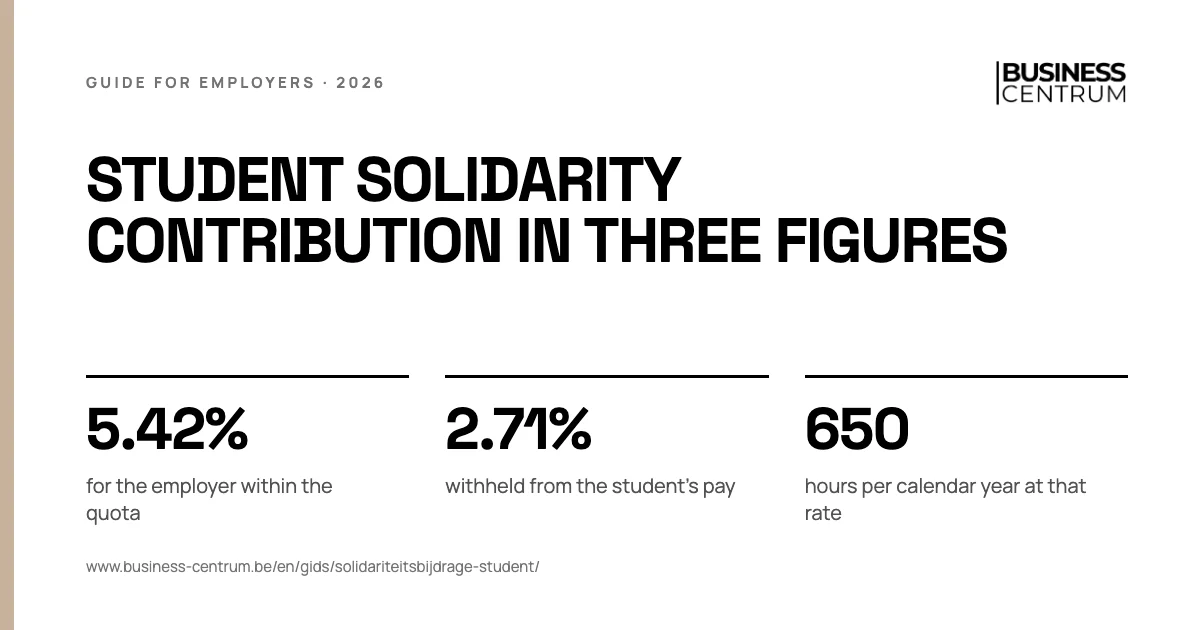
The solidarity contribution for a student in Belgium is 8.13% of gross pay: 5.42% for the employer and 2.71% for the student. It replaces ordinary NSSO contributions for at most 650 hours per calendar year, provided you sign a student contract and file a Dimona STU in advance. A student worker therefore costs you gross pay plus a little over 5 percent.
Below you read what you pay as an employer, when the reduced rate falls away and how to prevent that. The wider picture, with the contract, the minimum wage and the Dimona, is on our page about the student job from the employer's side.
Student solidarity contribution: how much does the employer pay, how much the student?
On the pay of an ordinary employee you pay a base employer contribution of 25% and you withhold an employee contribution of 13.07%. For a student who meets the conditions, the NSSO replaces those contributions with a single solidarity contribution of 8.13%. The student then stays outside the ordinary social security scheme for employees. That is why the contribution is so low, and why it builds up no holiday pay.
| Employer | Student | |
|---|---|---|
| Within the quota of 650 hours | 5.42%, plus 0.01% for the Asbestos Fund | 2.71% |
| Above the quota, or without a Dimona STU | base contribution of 25% | 13.07% |
| Ordinary employee, for comparison | base contribution of 25% | 13.07% |
Three things to remember:
- You pay everything to the NSSO. You withhold the student's share from the pay and transfer it together with your own.
- The Asbestos Fund contribution comes on top of your share. In principle the NSSO only collects it in the first and second quarter.
- The base is gross pay. The NSSO calculates the solidarity contribution on the pay that would otherwise carry ordinary contributions. Pay for a public holiday that falls after the end of the student contract is part of it.
What the ordinary contributions cover is explained in employer NSSO contributions.
What does a student worker cost the employer? A worked example
Take a student who works 120 hours for you in July and August at € 15 gross per hour. That hourly wage is an example: the real minimum depends on your joint committee and on the student's age, see the minimum wage in Belgium.
| With the solidarity contribution | With ordinary contributions | |
|---|---|---|
| Gross pay | € 1,800 | € 1,800 |
| Employer contribution | € 97.56 | € 450 |
| Cost to the employer | € 1,897.56 | € 2,250 |
| Cost per hour | € 15.81 | € 18.75 |
| Withheld from the student's pay | € 48.78 | € 235.26 |
With the solidarity contribution the student costs you € 1,897.56, or € 15.81 per hour. After the student's own contribution, € 1,751.22 is left. With ordinary contributions you pay € 352.44 more for the same hours. If the work falls in the first or second quarter, 0.01% for the Asbestos Fund is added: here € 0.18.
The column with ordinary contributions only counts the base contribution. In practice special contributions come on top and a reduction sometimes comes off, such as the structural reduction. How the full employer cost of an ordinary employee is built up is explained in calculating employer cost.
The solidarity contribution is not the only cost. Also count on:
- Pay for public holidays that fall within the contract, see is a public holiday paid?.
- Work accident insurance, which is compulsory for students too, and membership of an external prevention service.
- What your sector requires: a contribution to commuting costs, work clothing, premiums. Check the pay scale of your joint committee, for example PC 302 for hospitality or PC 201 for retail.
When does the solidarity contribution apply to a student?
The NSSO sets four conditions. If one is missing, you pay ordinary contributions.
- The person is mainly a student. You have to check that yourself. A sworn statement or a student card is not enough, a certificate of enrolment for the current school or academic year is.
- You sign a student contract. In writing, for each student separately, at the latest when work starts. If you can conclude a student contract, you are obliged to do so.
- The hours fall within the quota of 650 hours per calendar year, and you declared them in advance with a Dimona of type STU.
- The student works outside the periods of compulsory attendance at school.
Someone in evening classes or in education with a limited curriculum cannot sign a student contract. The same goes for someone who has already worked for you for 12 months without interruption. Successive contracts are added together. Only after a real break is it possible again.
Since 1 July 2016 the solidarity contribution is a choice. You and the student may agree that ordinary contributions apply, for example because the student wants to save the hours for another job. Put that choice in the contract and then declare the student in Dimona as EXT or OTH instead of STU. The person remains a student, only the contributions change.
When do you pay ordinary NSSO contributions after all?
| Situation | Consequence |
|---|---|
| The student works more than 650 hours in the calendar year | ordinary contributions from the first hour above the quota |
| No Dimona STU before the start | ordinary contributions on that pay, and the risk of a fine |
| More than 12 months in your service without interruption | a student contract is no longer possible |
| Evening classes or a limited curriculum | no student contract possible |
| You jointly choose ordinary contributions | Dimona EXT or OTH instead of STU |
| Work during compulsory attendance at school | the conditions are not met |
The most expensive mistake is a forgotten or late Dimona. The solidarity contribution then lapses, and a missing Dimona is a level 4 offence under the Social Criminal Code: an administrative fine of € 3,000 to € 35,000 per worker concerned. More in late Dimona and Social Criminal Code 2026.
The quota: which hours count for the student solidarity contribution?
- Only hours the student really works count. A paid public holiday or a sick day does not come off the quota, although you do pay the solidarity contribution on that pay.
- Only hours declared with a Dimona STU count.
- The quota applies per calendar year and per student, across all employers together. It starts again on 1 January.
That last point is the risk. You cannot see what a student already worked elsewhere. So ask for a Student@work certificate at every hire. It shows how many hours are left, with an access code that lets you check the balance yourself. The code stays valid in the month the certificate was created and the 2 months after that.
An example. A student already worked 580 hours for other employers this year and comes to work 100 hours for you in July. The first 70 hours fall under the solidarity contribution, the last 30 hours under ordinary contributions. With the certificate in hand you would have scheduled her for 70 hours, or known the cost in advance.
Working more is always allowed: the student contract stays in place, only the contributions change. See can a student work more hours than the quota?.
Declaring the student solidarity contribution: Dimona STU and DmfA
The declaration has two steps.
Before the start: Dimona STU. You register the student per quarter with type STU and the number of hours you plan. Those planned hours come off the student's quota. If the schedule changes, adjust the Dimona, otherwise hours stay reserved that the student needs elsewhere. The method is in Dimona declaration and, for students, in is a Dimona compulsory for a student?.
After the quarter: DmfA. In the quarterly return you declare the solidarity contribution in the student worker contribution block, with employee code 840 for manual workers and 841 for clerical staff. The solidarity contribution thus runs through the same quarterly return and the same payment as the contributions for your other staff.
If you would rather hand over the Dimona filings, our approach is on Dimona management.
Hiring a student worker in six steps
- Ask for the certificate of enrolment and the Student@work certificate with the remaining hours.
- Check the minimum wage in the pay scale of your joint committee, according to the student's age.
- Sign the student contract, in writing and at the latest when work starts.
- File the Dimona STU before the first working day, with the planned hours for the quarter.
- Track the hours worked and adjust the Dimona when the schedule changes.
- Process the pay: withhold 2.71%, pay your 5.42% and declare everything in the DmfA.
Hospitality, flexi-jobs and graduates
Hospitality. On top of the 650 hours, a student can work another 50 days per year as an occasional worker in hospitality. You declare the student hours as STU and the occasional days as EXT. On the student hours the NSSO calculates the solidarity contribution on the real pay, on the occasional days the contributions on a flat rate. No solidarity contribution is due on overtime under the hospitality overtime scheme. More in hospitality payroll.
Flexi-job. A student usually does not qualify for a flexi-job. Why is explained in can a student do a flexi-job? and in the flexi-job rules.
Graduated in June. Someone who graduates in June can still work under the solidarity contribution until 30 September of that year, as long as hours are left in the quota. After that the person works under an ordinary employment contract with ordinary contributions.
Student solidarity contribution in 2026: what applies now?
The percentages in this guide come from the NSSO administrative instructions for 2026. The quota of 650 hours is no longer a temporary measure: it has applied permanently since 1 January 2025. Before that the limit was lower. If you are already scheduling students for next year, count on the same quota and check the Student@work certificate at the start: every student's balance starts again on 1 January.
Are you a student? What the solidarity contribution means for you
Your employer withholds 2.71% from your gross pay. Within the quota that contribution builds up no holiday entitlement and no holiday pay. You can see how many hours you have left on Student@work, where you also create the certificate for your employer. Working more than 650 hours is allowed, but on the extra hours you pay 13.07% instead of 2.71%.
Common mistakes with the solidarity contribution
- Filing the Dimona too late. Without a Dimona STU in advance the reduced rate lapses and you risk a fine.
- Not asking for the Student@work certificate. You then do not know how many hours the student has left.
- Not checking student status. A student card is no proof, a certificate of enrolment is.
- Changing the schedule without adjusting the Dimona. The planned hours then stay deducted from the quota.
- Keeping a student in service for more than 12 months in a row. A student contract is then no longer possible.
- Counting last year's hours. The quota applies per calendar year.
What Business Centrum does for you
Business Centrum processes the pay of your students together with Acerta. We draw up the student contracts, file the Dimona STU, watch the quota and process the pay with the solidarity contribution. If you take on students every year, look at our approach for student workers. Want to know what a student costs in your sector? Get in touch.