
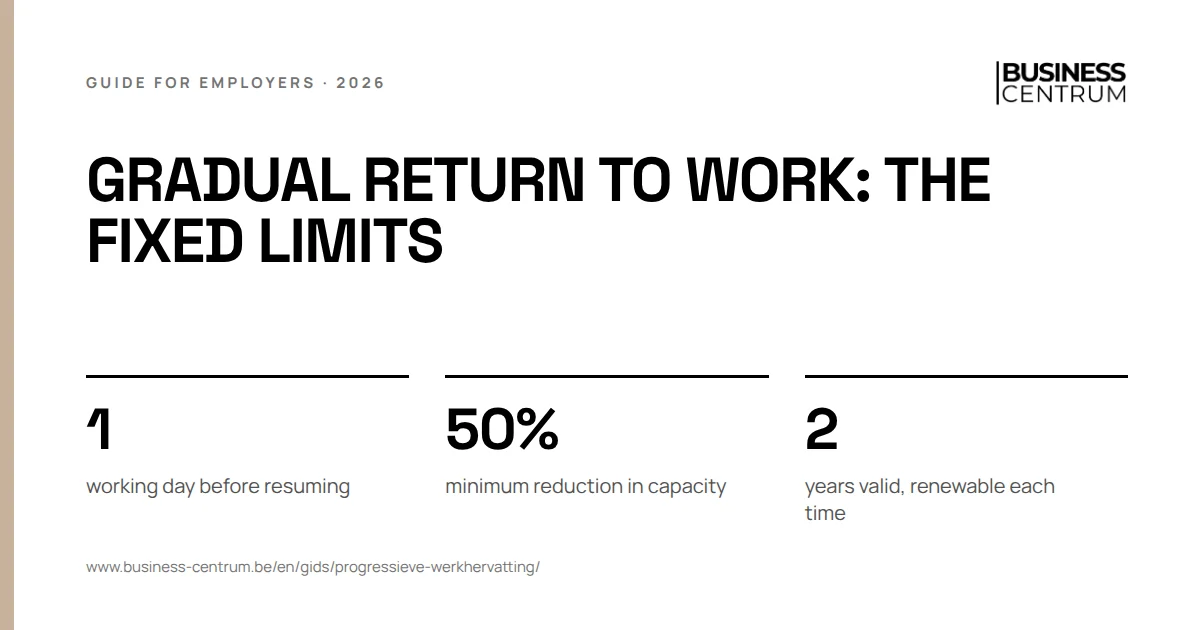
A gradual return to work means that an employee on sick leave comes back part-time or in adapted work while remaining officially recognised as unfit for work. He asks the advisory physician for permission no later than 1 working day in advance. You give your consent, you pay wages for the hours worked and the health insurance fund pays a reduced benefit.
For the employee, the procedure is on the health insurance fund's website. As an employer, your questions lie elsewhere: do you have to say yes, what do you put in writing, what do you pay, and what happens if he drops out again? This guide reflects the position on 1 November 2026, based on article 31/1 of the Employment Contracts Act, the rules of the NIHDI (RIZIV) and the Code on well-being at work. The general rules on sickness are in employee on sick leave.
What is a gradual return to work?
The law speaks of adapted or other work, the health insurance fund of authorised work, and practice of a gradual or part-time return to work. It is always the same thing: an employee recognised as unfit for work by his health insurance fund does, with the advisory physician's permission, work that suits his health. Often that means fewer hours, sometimes different work or an adapted workstation.
Article 31/1 of the Employment Contracts Act, inserted by the Act of 20 December 2016, puts it like this: "The performance of the employment contract is not suspended when the employee, recognised as unfit for work (...), temporarily performs adapted or other work with the employer's consent." Three consequences for you:
- The contract simply continues. There is no suspension of the employment contract for the hours he works.
- The previous employment relationship is presumed to continue. After the period, the employee returns to his usual job and working hours.
- The employee keeps all the benefits he has acquired with you, unless you agree otherwise in an annex.
| Element | Gradual return to work | Full return |
|---|---|---|
| Employee's status | Remains recognised as unfit for work | No longer unfit for work |
| Permission needed | From the health insurance fund's advisory physician | None |
| Who pays | You for the hours worked, the health insurance fund a reduced benefit | You the full salary |
| Employment contract | Continues, with an annex for the period | Continues as before the illness |
| New illness during the period | No guaranteed salary at your expense | Ordinary guaranteed salary rules |
Applying for a gradual return to work: steps and deadlines
The application lies with the employee, not with you. According to the NIHDI, it works like this, "no later than the 1st working day immediately before your return to work":
- The employee notifies his health insurance fund of the return to work, using the form he receives there.
- With the same form, he asks for the advisory physician's permission.
- He may then start straight away, "even before you have received the written permission of your health insurance fund's advisory physician".
- The advisory physician has 30 working days from the return to deliver his written permission.
The advisory physician gives permission when two conditions are met: the work is adapted to the illness, and the employee retains a reduction in capacity of at least 50% on medical grounds. The permission states the nature of the work, the volume and the conditions. It is valid for at most 2 years and can be renewed each time for at most 2 years.
Worked example
A white-collar employee has been ill for three months after an operation. He wants to return half-time on Wednesday 13 January, 19 hours out of his usual 38 hours a week.
- He notifies the return and asks for permission no later than Tuesday 12 January, 1 working day in advance. If he wants to start on Monday 11 January, the last day is Friday 8 January.
- You agree beforehand on which days, which tasks and what pay. You record that in an annex to the employment contract.
- 19 hours out of 38 is half of a full-time job. The health insurance fund leaves 20% out of account and reduces the benefit for the share above it.
- You pay wages for the 19 hours worked. If he catches the flu in February, you pay no guaranteed salary for those days.
Exactly how much the benefit drops depends on the volume and the daily amount. The health insurance fund calculates that. Your social secretariat processes the hours worked and the pay in the payroll and the returns. The pay calculation itself follows the same logic as for a part-time employment contract.
Refuse a gradual return to work: can the employer say no?
This is the question employers ask most often. The answer depends on the route by which the request comes in.
A request from the employee himself, outside a pathway. Article 31/1 requires the employer's consent. The law does not oblige you here to accept every request. Do not simply say no: look at which tasks, hours or adjustments are possible, and record your decision in writing. An employee who is turned down can always ask the occupational physician for a reintegration pathway.
A formal reintegration pathway. Here the rules are tighter. If the occupational physician finds that the employee is temporarily or permanently unfit for his job but can do adapted work, then according to the FPS Employment you must "seriously examine the concrete options for adapted or other work or adjustments to the workstation" and draw up a reintegration plan. If that is not possible, you explain in a report why it is "technically or objectively impossible, or cannot reasonably be required on well-founded grounds" (art. I.4-74, §4 of the Code).
| Situation | What you must do | Deadline |
|---|---|---|
| Request from the employee without a pathway | Give consent or not, preferably in writing and with reasons | No statutory deadline, but before the return |
| Pathway, decision A: temporarily unfit | Reintegration plan or reasoned report | At most 63 calendar days |
| Pathway, decision B: permanently unfit | Reintegration plan or reasoned report | At most 6 months |
| Pathway, decision C: not yet appropriate | Nothing, the pathway stops | New pathway after 3 months at the earliest |
A reasoned report can only follow a genuine examination and consultation. A one-sentence report without a conversation is not enough. If you later want to dismiss an employee on grounds of medical force majeure, you need that report or the refused plan when the employee had asked for adapted work.
Adapted work within the reintegration pathway
The formal pathway is a second route to a gradual return to work. The FPS Employment itself calls it "a useful tool" for people who cannot yet manage full-time work after a serious accident or cancer treatment. The pathway runs as follows:
- The employee, his treating doctor or you request a pathway from the occupational physician of your external prevention service. You can only do so with the employee's agreement, or if the prevention service finds work potential after at least 8 weeks of incapacity.
- The occupational physician examines the employee and decides within 49 calendar days of the request.
- You draw up the plan, in consultation with the employee and the occupational physician.
- The occupational physician sends the plan to the advisory physician, who has 3 weeks to give a view on authorised work. Without a response within that period, authorised work may be assumed to be possible.
- The employee has 14 calendar days to accept or refuse the plan.
Since 1 January 2026, every employer with at least 20 employees must start a pathway within 6 months of the start of the incapacity once work potential has been established. What else changed in 2026 is in reintegration 2026. The tasks of the occupational physician are described in the occupational physician.
Separately from the pathway, employees under health surveillance have a return-to-work examination after at least 4 weeks of absence, no later than the 10th working day after the return.
The annex to the employment contract for a part-time return to work
Article 31/1, §3 allows you and the employee to conclude "an annex to the employment contract" for the period of adapted work. The law gives these examples:
- the volume of the adapted or other work;
- the working hours;
- the nature of the work;
- the pay for the adapted or other work;
- the period of validity of the annex.
Always put that annex in writing. Without an agreement on paper, it is unclear how many hours the employee has to work, what pay he receives and when the arrangement stops. An addendum to the employment contract is the right form, and a part-time work schedule helps with the days and hours.
The annex ends by operation of law: it "ends immediately when the employee no longer meets the conditions" of the health insurance fund. The employee must then inform you. From that moment his ordinary contract applies again, with his usual hours and pay.
Pay and guaranteed salary on a return to work after illness
You agree the pay for the hours worked. The benefit is paid by the health insurance fund, not by you. Three rules for the employer:
| Question | Rule | Source |
|---|---|---|
| New illness or ordinary accident during adapted work | No pay borne by the employer | Art. 52, §5 (blue-collar) and art. 73/1 (white-collar), Employment Contracts Act |
| Occupational accident or occupational disease during adapted work | That exception does not apply: ordinary rules | Same articles |
| Dismissal during adapted work | Notice pay based on the pay without adjustment | Art. 39, §2, Employment Contracts Act |
No guaranteed salary for a new illness. During the period of adapted work, there is "no pay borne by the employer in the event of incapacity for work due to an illness, other than an occupational disease, that occurred during this period". Since 1 January 2026, this applies to the whole period of adapted work. The health insurance fund then takes over. More on the ordinary rules is in guaranteed salary.
Dismissal during the period. The law gives no separate dismissal protection for adapted work, but a dismissal because of the employee's state of health can amount to discrimination. Under article 39, §2, you calculate the notice pay on the pay "to which the employee would have been entitled (...) if he had not adapted his work performance with the employer's consent". So on the full-time pay, not the part-time pay. Read dismissing an employee during illness and calculating compensation in lieu of notice first.
Replacement for the lost hours. Article 11ter, §3 lets you hire a replacement for the hours the employee in adapted work does not work, with a replacement contract. That replacement comes on top of the employee, not in his place.
Employer checklist for adapted work
A short decision aid so you miss nothing:
- Does the request come within a pathway? Then the deadlines and the duty to give reasons under the Code apply. Without a pathway, you decide together with the employee.
- Has permission been requested? The employee files the notification and the application with his health insurance fund, no later than 1 working day in advance.
- What work fits? Follow the restrictions set by the treating doctor, the advisory physician or the occupational physician. For stress or burnout, see also burnout in an employee and psychosocial risks.
- Annex drawn up? Volume, working schedule, nature, pay and duration, signed by both parties.
- Return-to-work examination needed? For an employee under health surveillance after at least 4 weeks of absence.
- Payroll informed? Pass on the start date, the hours and the pay for the first pay period.
- End in sight? Note the validity of the permission, at most 2 years, and plan a conversation about extension or a full return.
Mistakes in a gradual return to work
- Not drawing up an annex. That leads to arguments about hours and pay, and about when the employee has to go back to full-time work.
- Paying guaranteed salary for a new illness. During adapted work it is not due, except for an occupational accident or occupational disease.
- Refusing a request within a pathway without a report. Without a reasoned report you miss a step you will need later in a case of medical force majeure.
- Letting the employee resume without an application. The step the health insurance fund requires in advance is then missing, and that falls back on the employee.
- Calculating notice pay on the part-time pay. The law takes the pay without adjustment.
- Confusing a control doctor with the advisory physician. A control doctor checks the incapacity for you, the advisory physician gives permission for adapted work.
What Business Centrum does for you
Business Centrum is a social bureau in Ghent, founded in 2013, and a recognised partner of Acerta. You supply the start date, the working schedule and the pay for the adapted work, and we process them through Acerta, the recognised secretariat with number 250, which files the returns. Your fixed contact person helps you with the annex, the processing of the hours worked and a new illness during the period. More on the processing is in payroll administration and leave and absence. How the work is divided between Business Centrum and Acerta is set out in Business Centrum and Acerta.
Is an employee on sick leave coming back part-time and do you want to be sure the annex, the pay and the hours are right? Request a call back and Business Centrum goes through the approach with you. For medical questions we refer you to the occupational physician, and for a dispute about dismissal or discrimination to a lawyer or your sector federation.