
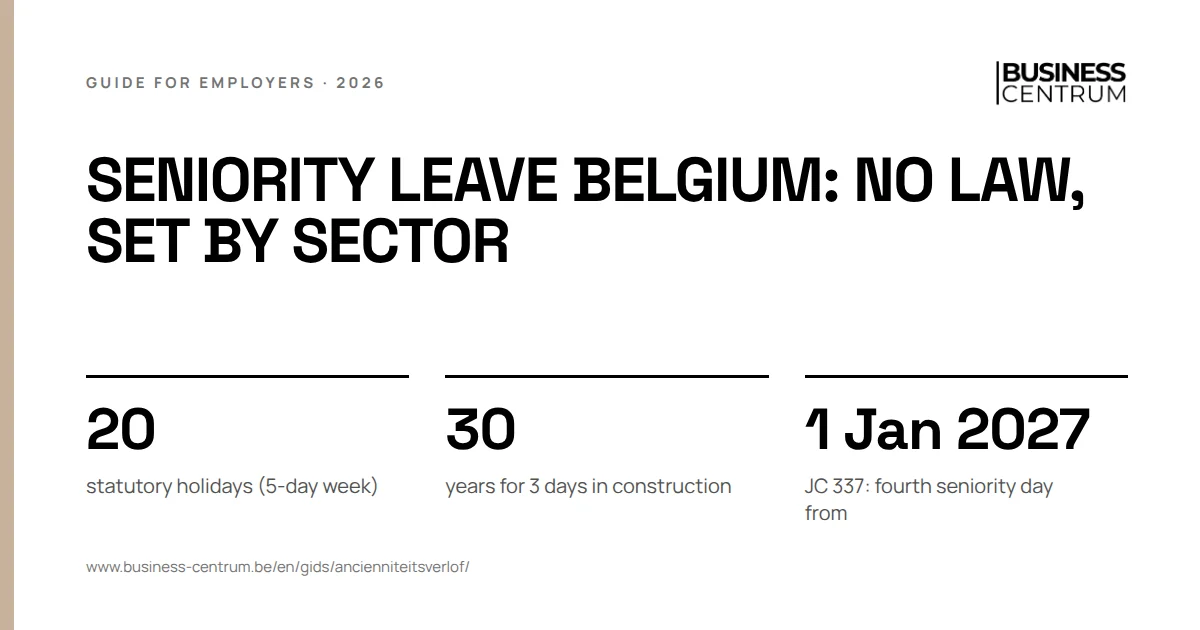
Seniority leave is not a legal right in Belgium. The number of statutory holidays depends on what your employee worked last year, not on years of service: someone who worked full time in a five-day week gets 20 days, whether he has been with you for two years or thirty. Extra days for loyal staff come from a sector agreement, a company agreement, the work rules or the employment contract. What each joint committee grants is listed below by sector, with the collective agreement it comes from.
What is seniority leave in Belgium?
Seniority leave, also called seniority days (anciënniteitsverlof in Dutch, congé d'ancienneté in French), means paid days off on top of the statutory holidays, granted because an employee has a certain number of years of service.
Holiday law counts differently. The royal decree of 30 March 1967 on annual holidays gives a white-collar employee 2 holiday days per month of work or equivalent absence in the reference year, and statutory holidays may not exceed 4 weeks. For blue-collar workers a table of working days applies. Nowhere in those rules does seniority with the employer play a role. How to calculate the statutory days is explained in holiday days 2027.
Three things are often confused with seniority leave:
- The long-service bonus is money, not leave. You may grant it free of social security and tax in the year of 25 and of 35 years of service, and in construction it is compulsory: € 500 and € 700. Everything about that bonus is in long-service bonus.
- European or supplementary holidays are for starters and people returning to work who have not yet built up full statutory holidays. They open after a start-up period of 3 months of work and have nothing to do with seniority.
- Career leave and end-of-career days depend on age, sometimes combined with a minimum length of service. Metalworking and food have them. They appear in the table below because people often ask about them at the same time.
An overview of all other types of leave, from short leave to time credit, is in types of leave.
Where does seniority leave come from?
A right to seniority days can come from four sources.
- A sector agreement of the joint committee. It applies to all employers of the committee once it has been declared generally binding. Find your committee with find your joint committee.
- A company agreement, concluded with the trade unions in your company.
- The work rules. A scheme set out there applies to everyone covered by the rules.
- The employment contract or an annex to it, for one employee. A fixed practice, applied for years without exception, can also create a right.
Where both a sector scheme and your own scheme exist, the sector agreement decides how they combine. In construction a more favourable company scheme still applies and a less favourable one is automatically raised to the sector level. In the food industry (JC 118) and the food trade (JC 119), existing company days are offset against the sector day. In JC 337, companies that already had seniority days before the sector scheme fall entirely outside the agreement.
Seniority leave in Belgium by joint committee
This table follows the committees employers search for most. For each committee we checked all agreements in the collective agreements database of the FPS Employment, Labour and Social Dialogue on 25 October 2026.
| Joint committee | Scheme | For whom | Source |
|---|---|---|---|
| JC 124 construction | one day from 15 years, two days from 25 years, three days from 30 years with the same company | blue-collar workers | agreement of 26 June 2023, 181714/CO/124 |
| JC 200 white-collar staff | no sector scheme found (checked 25 October 2026) | white-collar staff, including in construction | agreements database |
| JC 201 independent retail | no sector scheme found (checked 25 October 2026) | white-collar staff | agreements database |
| JC 111 metalworking | fitters: one day from 5 years, two days from 15 years; rest of the sector: no seniority leave, but career leave from age 50, 58 and 60 | blue-collar workers | 107602/CO/111.03 and 184505/CO/111 |
| JC 209 metalworking white-collar | no seniority leave, but career leave from age 50, 58 and 60, after 6 months of service | white-collar staff | 184147/CO/209 |
| JC 112 garages | one day after 12 years with the company, since 1 January 2026 | blue-collar workers | 199471/CO/112 |
| JC 116 chemicals | one day after 15 years, two after 20, three after 30; from age 60 topped up with at most 2 age days, never more than 3 days in total; plastics processing: in West Flanders from 4 years up to 7 days (197638/CO/116), in Limburg from 4 years up to 8 days (199110/CO/116) | blue-collar workers, at an average of 38 hours a week | agreement of 13 February 2026, 198270/CO/116, since 1 July 2026 |
| JC 207 chemicals white-collar | one day after 15 years, two after 20, three after 30, same age rule as JC 116 | white-collar staff | 198278/CO/207, since 1 July 2026 |
| JC 118 food industry | one day a year after 20 years with the company, on top of end-of-career days | blue-collar workers, bakeries included | 198180/CO/118, since 1 January 2026 |
| JC 119 food trade | one day after 20 years' unbroken service | blue-collar workers | 196834/CO/119 |
| JC 121 cleaning | one day per 1,000 social security days shown on 5 consecutive year-end bonuses, at most 7 days | blue-collar workers, seniority in the sector | agreement of 2 July 2026, 200883/CO/121 |
| JC 145 horticulture | 1 day from age 45 with 10 years' sector seniority, 3 days from age 50 and 5 days from age 55, each with 15 years | blue- and white-collar staff | 199668/CO/145 |
| JC 302 hospitality | under 50 employees: from 10 years, one extra day at every anniversary of the contract that is a multiple of 5 years; from 50 employees: one extra day every 5 years, so already from 5 years; plus one extra day from age 56 | all employees, part-timers pro rata | 133461/CO/302 and 58955/CO/302 |
| JC 337 non-profit | one day from 3 years, two days from 7 years; from 1 January 2027 also three days from 10 and four from 13 years | blue- and white-collar staff | 170624/CO/337 and 200981/CO/337 |
Full pay and working conditions by sector are in the committee guides, including JC 124, JC 118, JC 121, JC 145, JC 302 and JC 337.
Seniority leave in construction: blue- and white-collar staff
In construction, seniority leave is a right of the blue-collar worker, paid by the employer. The agreement of 26 June 2023 has applied since 1 July 2023 and added the third day from 30 years. The right starts in the year in which the worker reaches the threshold, from the day he reaches it. The employer only pays a day that is actually taken. If the worker could not take the day because of a suspension or the end of his contract, no wage is due, and the day cannot be carried over either. Seniority leave is separate from rest days and the construction holiday, which you find in construction leave days 2027.
A white-collar employee of a construction firm does not fall under JC 124 but under JC 200. We found no sector scheme there, so seniority leave for a white-collar employee in construction only exists if your company grants it. More about the sector in the guide to JC 124.
Seniority leave for white-collar staff in JC 200
We are often asked about seniority leave in JC 200. The answer is short: in the agreements database, checked on 25 October 2026, no agreement of JC 200 grants seniority days. Whatever a white-collar employee in JC 200 gets comes from a company agreement, the work rules or his contract. If you have such a scheme, put in writing from how many years, how many days, how the employee requests them and what happens when he leaves. For the rest of the white-collar sector, read the guide to JC 200.
Metalworking: seniority leave and career leave
Metalworking has no general seniority leave. Blue-collar workers in JC 111 and white-collar staff in JC 209 get career leave according to age. In JC 111 that career leave comes on top of seniority days the company already granted, and a day not taken is paid out when the worker leaves. Only fitters of bridges and steel frames and lifting firms (section 111.03) have real seniority days. See also the guides to JC 111 and JC 209.
Decision guide: is my employee entitled to seniority leave?
| Question | If yes | If no |
|---|---|---|
| 1. Does his joint committee have a sector scheme (table above)? | Go to question 2. | Go to question 4. |
| 2. Does he reach the seniority, counted the way the agreement counts it (with the company, in the sector, with or without agency work)? | Go to question 3. | No sector right yet; go to question 4. |
| 3. Does your company already grant as many days or more? | Your scheme usually suffices; do check the agreement's offsetting rule. | He is entitled to the sector days. |
| 4. Does a company agreement, the work rules or his contract say anything? | He is entitled according to that text. | He is not entitled to seniority leave. |
| 5. Have you given everyone extra days for years without a written rule? | Possibly a right by practice; put it in writing or end it properly. | No right. |
Part-time employees get the same rights pro rata under most agreements, for instance in JC 112, JC 119, JC 302 and JC 337.
Carry over seniority leave to next year?
For statutory holidays the rule is strict: they must be taken within the year, except days lost through illness among other reasons, which the employee may still take within 24 months after the holiday year. For seniority days the scheme itself decides.
| Committee | Pay and who pays | Carry over to next year | On leaving |
|---|---|---|---|
| JC 124 construction | employer, public holiday pay | no | a day not taken is not paid |
| JC 118 food industry | paid day off | no, and not payable in cash | not payable |
| JC 119 food trade | public holiday pay | no | agreement is silent |
| JC 116 plastics Limburg | agreement is silent | yes, if the employee also worked that year | agreement is silent |
| JC 302 hospitality | public holiday pay | yes, if taking it was impossible for a reason other than a suspension | agreement is silent |
| JC 111 career leave | public holiday pay | only with a written collective agreement in the company | paid in the next pay period |
| JC 121 cleaning | value of a public holiday; the social fund supplies the list of those entitled | the agreement says: granted and taken in the calendar year | agreement is silent |
| JC 145 horticulture | employer, the social fund fully reimburses wage and social security | agreement is silent | agreement is silent |
Where the scheme is silent, carrying over or paying out is a grey area. Write it into your own scheme. As for carrying days over to a new employer: where seniority with the company counts, the employee starts again from zero. Only JC 121 and JC 145 count the sector, and JC 118 counts agency days in the 24 months before the contract.
How do you process seniority leave in payroll?
- Pay. Almost every sector agreement refers to public holiday pay, calculated under the royal decree of 18 April 1974. You pay the normal wage for the hours the employee would have worked that day, with the usual social security and withholding tax.
- Declaration. A seniority day with pay is declared in the DmfA under working time code 1, the code for absences with normal pay and social security. Do not confuse it with supplementary holidays, which have code 14. In JC 145 the days must be identifiable on the payslip or in the DmfA, because the fund reimburses them.
- Leave management. Keep seniority days as a separate counter next to statutory holidays, with the date on which the employee reaches the threshold. That is the moment to plan them, together with the collective closures in the leave calendar 2027.
- Year-end bonus. In JC 116 and JC 207 seniority and age days count as actual work for the bonus; see year-end bonus JC 116.
- On dismissal or notice. Preferably have the employee take his days during the notice period. What happens to a day not taken differs by agreement (table above). Exit holiday pay and the holiday certificate concern statutory holidays; see holiday certificate and employer notice period.
Worked example
Worked example: a construction worker and a part-time employee in 2027
Construction (JC 124). A worker has been employed since 1 September 2002. On 1 September 2027 he has 25 years of service. In 2027 he is entitled to one day from 1 January, because he already has more than 15 years of service, and to a second day from 1 September, because he then reaches 25 years.
| Day 1 | Day 2 | |
|---|---|---|
| Can be taken from | 1 January 2027 | 1 September 2027 |
| Hours that day | 8 | 8 |
| Hourly wage | € 20 | € 20 |
| Gross wage for the day | € 160 | € 160 |
Together that costs € 320 in gross wages, plus employer contributions. If his contract ends on 30 June 2027 before he took day 1, no wage is due for that day, and day 2 never arises.
Non-profit (JC 337). An employee works four-fifths and has 13 years of service in 2027. From 1 January 2027 a full-time employee with 13 years of seniority has four days. She gets them pro rata: 4 x 0.8 = 3.2 days. On a full-time schedule of 7.6 hours a day, that is 3.2 x 7.6 = 24.32 hours of paid leave.
What such a day yields net for the employee can be worked out with the gross-net calculator.
What changes in 2027 for seniority leave?
One change is official: in JC 337, from 1 January 2027, a third day is added from 10 years and a fourth from 13 years of seniority. Those two days are not due if your organisation already grants at least as many extra days off.
Other schemes changed during 2026 and so apply for a full year for the first time in 2027: the new thresholds in JC 116 and JC 207 since 1 July 2026, the sector day in JC 118 since 1 January 2026, the day after 12 years in JC 112 and the days off in JC 145 since 1 January 2026.
What Business Centrum does for you
Business Centrum checks which agreement applies to your staff, works out for each employee when he reaches a threshold and sets up seniority days as a separate counter in your leave management. When processing your payroll together with Acerta, we pay the day at the right wage and declare it correctly in the DmfA. Want to grant seniority days yourself? We help you put them in writing. Have your scheme checked.